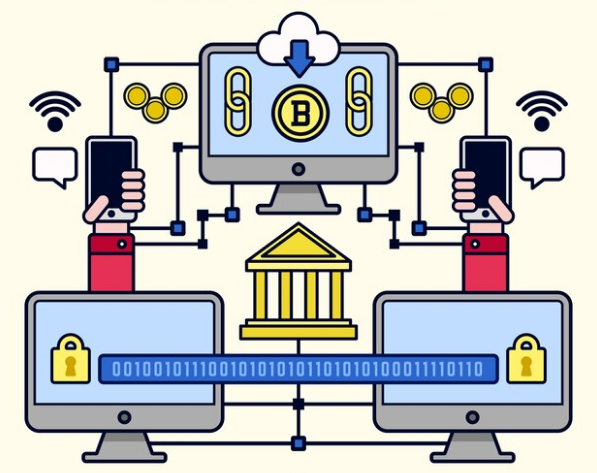
The utilization of blockchain in the U.S. finance sector has marked the beginning of transparency, security, and efficiency in financial transactions and processes. By decentralizing data, blockchain reduces the risk of fraud and errors, enhancing trust in the system.
Moreover, its immutable nature ensures that every transaction is traceable, creating a robust audit trail that further strengthens financial integrity. It is a revolutionary technology that is revamping the conventional sources of financial approaches and can greatly revolutionize the entrenched models of regulation and operation.
Blockchain’s potential to streamline compliance and reduce costs is unprecedented, making it an attractive solution for both financial institutions and regulators. Additionally, its ability to facilitate faster and more secure cross-border transactions could reshape global finance, fostering greater economic collaboration.
The impact of blockchain on financial transactions

Another area that is prominent to be benefited from the blockchain technology is the improvement of financial processes. Due to distributed ledgers, these technologies provide accurate data, and very little or no fraudulence or corruption is evident.
Ledgers are made on many nodes and once a record is made, it cannot be changed or erased. This unchangeable characteristic make people placing more confidence among financial parties, thereby giving higher reliability.
In addition, it eliminates the need for intermediaries through smart contract whereby terms and fail-safes are embedded, and are set to go off once certain conditions are met. Cutting out the middle man not only quickens the process of exchange among the business but also lowers the costs of exchange, thus bringing efficiency in the process of finance.
Innovative applications in banking
In the banking sector, there has been lots of development that has been brought about by the integration of blockchain. Various institutions such as banks are applying this type of technology in a number of areas, including cross border clearance that is handled more efficiently and at lower cost by blockchain than the conventional money transfer methods.
Also, the processes of trade finance that used to involve a lot of paperwork and take time are slowly being automated. Smart deals are applied to facilitate agreements, which in turn greatly minimizes the time and cost of the conventional trade finance.
From the risk assessment perspective, blockchain can also bring in more effective and better tools, which can reduce the risk aspects attached with banking operations and make the banking environment more secure and effective.
Future prospects and challenges
Nevertheless, applying the blockchain in the US financial industry is accompanied by certain challenges. First, there is a question of specific regulation and sanctions for its breach, which discourages cooperation based on legal agreements.
From the case study of blockchain, it can be deduced that as technology advances, the nature of the financial systems also progresses and the regulating policies ought to follow in match. However, problems of conversion and compatibility as well as of system extension still remain.
With more and more financial institutions currently implementing blockchain technology, it becomes essential to come up with the way to make the different blockchains to interact efficiently. On one hand is the equation with this depletion against the potentials of blockchain technology in finance, which will define its future course.
The role of blockchain in financial security
Security is a significant aspect of the financial sector, and using the blockchain technology is a way of improving on this area. Some of the strengths of blockchain include that the distributed ledger of all the activities is encrypted and the fact that all transactions are linked to the previous ones through cryptographic means.
This high level of security minimizes the cases of fraud, and access to unauthorized individuals or groups. Modern systems do not have a single central authority point where resources and people’s information is easily controlled, as exists in conventional monetary systems.
This makes financial data more safe and sound from acts of cyber-crimes and breaking. Increased transparency also translates to real-time audit, which plays a crucial role in identifying some of the activities as fraudulent or noncompliant, and in compliance with the regulatory requirements.
Enhanced fraud prevention
Other risks have and will always remain relevant in the financial services industry, especially fraud risk. Blockchain is implemented in such a way that it has a distributed ledger system, and this assists in the prevention of frauds. The information can easily be retrieved and audited by all the parties to the transaction, which practically makes it difficult to tamper with the records.
Also, being a digital transaction, every transaction that takes place is verified and encrypted and is capable of pointing towards fraudulent activities that occur in a financial institution, hence creating more trust in the existing institutions. Thus, the openness and purity of information entail that parties can transact knowing well that risk of fraud in the market is almost negligible.