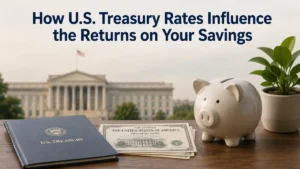
Balancing the individual’s affairs can be quite difficult, and especially since such rates form a critical component of most economic agendas. The varying interests affect both costs of borrowing and on the other hand savings and investment. It is vital in personal finance and managing for success in the USA to understand the way rates of interests work.
This, therefore, brings us to discuss how interest rates affect borrowing and saving or rather investment. In this manner, we need to offer the reader a guide that will include all the key aspects that govern financial decisions. Check all the informations:
The influence of interest rates on borrowing

Concerning borrowing, interest rates are a basic component that can impact the price of the credit. Lower rates normally imply that borrowing is cheaper and people go for loans for things like houses or cars. On the other hand, high rates which are also referred to as high costs can be looked at in the aspect that can reduce the number of people willing to borrow.
Thus, for example, if you are planning to take a mortgage, relatively low interest rates will make the overall cost of owning a house less. On the other hand in high interest environment, monthly payments are likely to get significantly costly thereby exerting pressure on the monthly cash flow. Hence, knowing the current interest rate is pertinent when it comes to assuming more debts or when it comes to refinance those debts.
The role of federal reserve
The US interest rates especially the key rates are well controlled by the Federal Reserve Bank. It seeks to have maneuverability to achieve its objective of growing the economy together with the fight against inflation that is through its monetary policy.
Relative to other types of rates including mortgage, credit and personal loan rates, the setting of the federal funds rate indirectly controls these other rates through an increase or a decrease by the Federal Reserve Bank.
Before translating in to costs of borrowing, it is important to understand the Federal Reserve’s policy decisions with the aim of predicting changes in such costs in the future. For instance, in situation of recession, the federal fund rate might be reduced in order to encourage increased borrowing decision. On the other hand rates might be raised in the event that the country is experiencing high economic growth so as to curb inflation.
Impact on mortgage rates
Mortgage rates are among the most important for homeowners as well as any representative of the potential buyer. In periods of low interest rates, mortgage rates also drop and help in purchasing of homes and in cases where one wants to change the mortgage provider.
This in a way puts more people into the market to look for homes thus increasing the demand for homes. Again when the interest rates go up then the price for a mortgage rises and this helps slow the real estate market.
This can force buyers to move out of their desired homes due to higher monthly payments while other homeowners can turn down mortgage refunding companies, due to the higher costs on their mortgages. Therefore, it helps to know how mortgage rates move up and down with other rates of interest so that you can time your purchases and refinancing to perfection.
The impact of interest rates on saving and investing
Speaking of interest rate, it is not an element that only influences new loans but also relate to savings and investments. In general, the rates with greater figures provide more beneficial interest in savings accounts and fixed-income investment. The flip side of the fact is that lower rates mean that even your savings are going to generate less return.
This will therefore imply that in the low interest rate environment you may have to search for other investments to fulfill your goals. For examples, the stock investment or real estate could provide higher yields compared to the saving instruments. Knowledge of these factors will assist you plan for the best way of saving and investing depending on the most current and prevailing interest rates.
High-interest rates and savings accounts
Savings accounts and hence, certificates of deposit ( CD’s ) holder are paid relatively higher rates when interest rates are high. It can be useful especially for risk averse people who can earn a steady income in the long term without risking their capital. They also imply that bonds and such other fixed income instruments will generate much higher return which will considered good for risk averse investors.
Nonetheless, these options are sacrifices in regards to liquidity since most high returns are accompanied by the same. It enables you to know when it is time to invest in high-interest instruments, by analyzing the correlation between rates of interest and the forms of saving.